
Hello, it’s Patrick.
Insulating a wall from the inside without checking its condition or addressing moisture can turn a good project into a false start.
Internal insulation improves comfort and can reduce heat loss, but it needs to be part of a well-planned energy renovation. Before choosing insulation, inspect the wall, ventilation, and thermal bridges.
Good practices to follow before insulating a wall
- Look for signs of moisture and address the cause before starting work.
- Check the home’s ventilation, especially in damp rooms.
- Choose the method according to how even the wall is and how much space is available.
- Plan for outlets and fixtures before closing up the lining.
- Address problem areas to limit thermal bridges and air leaks.
To plan your project, consult this practical guide to insulating an interior wall and these tips on how to avoid insulating without a prior assessment. The right place to start is by understanding the wall, not by immediately buying insulation boards.
The pitfall: insulating a wall without addressing the cause
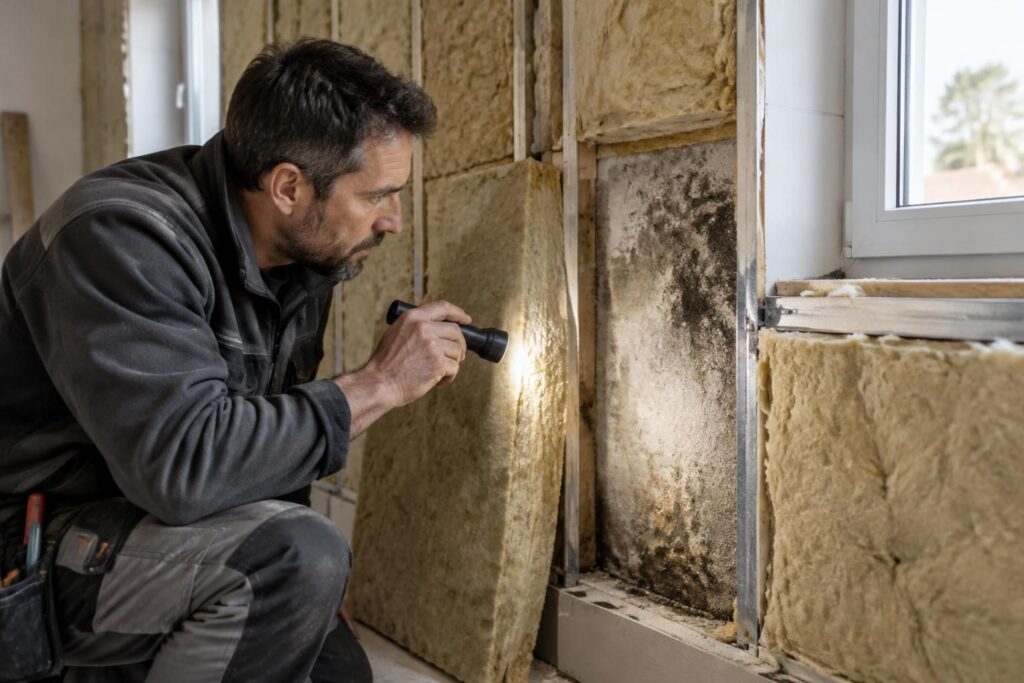
A dark stain, a musty smell, or peeling paint won’t be fixed by adding a lining. If the water is coming from a leak, rising damp, or water ingress, the insulation could hide the problem and deteriorate behind the finish.
Condensation is another risk. By changing the wall’s temperature, thermal insulation can encourage moisture to build up within the wall layers if the system is poorly designed. A suitable membrane may be necessary, but the choice depends on the substrate and wall composition: using one by default is not appropriate for every building.
Ventilation matters just as much as insulation. A better-sealed home needs to renew its air effectively. Otherwise, the moisture generated by cooking, showering, and breathing can accumulate, even if the wall looks brand new.
A real-life example: Nadia’s cold bedroom
Nadia wants to insulate the north wall of her bedroom because it feels cold to the touch. Before getting started, she discovers water ingress near a window and inadequate ventilation in the bathroom. Adding a lining straight away would have hidden the leak without fixing it.
After the repair and improving air circulation, she can compare the options. This detour saves her from redoing the finishes a few months later: insulation is no substitute for assessing and repairing the substrate.
Choosing materials and methods for internal insulation
Adhesive-bonded lining is quick and takes up little space, but it requires a sound, fairly even wall. A metal frame makes it easier to compensate for unevenness and provides space for running cables and pipes; in return, it reduces the usable floor area more.
Glass wool and rock wool are common options and are often moderately priced. Bio-based insulation materials, such as wood fiber or cellulose wadding, can provide good comfort and offer interesting moisture-management properties, provided they are used in a suitably designed system. Polyurethane offers high thermal resistance with less thickness, but it is generally more expensive.
The figures below are estimates. Performance and cost vary depending on the products, their installation, and the conditions on site.
| Material | Indicative thickness for R ≈ 3.7 | Indicative price per m² |
|---|---|---|
| Glass wool | 12 to 17 cm | €15 to €25 |
| Rock wool | 12 to 16 cm | €20 to €30 |
| Expanded polystyrene | 11 to 14 cm | €10 to €20 |
| Polyurethane | 8 to 10 cm | €25 to €35 |
| Wood fiber | 13 to 17 cm | €25 to €40 |
| Cellulose wadding | 13 to 16 cm | €20 to €30 |
A thermal resistance of around R = 3.7 m²·K/W is often used as a benchmark for comparing options, but it alone does not guarantee the home’s energy performance. Connections to windows, floors, and ceilings matter too: poorly installed high-performance insulation can still leave a significant thermal bridge.
Three installation steps to avoid a false start
- Assess the wall. Look for cracks, water ingress, rising damp, and unevenness. Have any problems fixed before closing up the wall, and check that the ventilation is working.
- Choose a system suited to the project. Adhesive-bonded lining may work on an even, sound wall. On an uneven wall, or if services need to be routed, a metal frame is often more practical. Measure how much floor space you can afford to lose before choosing the thickness.
- Ensure continuity and take care with the finishing. Install the insulation without compressing it, minimize gaps between boards, and address corners and the edges of openings. Follow the manufacturer’s instructions for any membrane and for boards suitable for damp rooms.
Before closing up the wall, check every joint and cable or pipe penetration. Much of the final result depends on this stage—far more than on the choice of decorative finish.
The right decision also depends on the space available
Internal insulation takes up room. With a frame system, the total thickness includes the insulation, the framing, and the facing board: a few extra centimeters can make a difference in a hallway or small bedroom. Higher-performance, thinner boards may help, but compare their cost with the actual space saved.
The professional’s advice is simple: don’t choose based solely on the price per square meter. Weigh the condition of the wall, the comfort you want, the loss of floor space, and the quality of the installation. A well-planned energy renovation may also include windows and doors, heating, or ventilation, depending on the home’s weaknesses.
Frequently asked questions about internal insulation
What thickness should I choose to insulate an interior wall?
The thickness depends on the material, the target thermal resistance, and the space available. For a common insulation material, around 12 to 15 cm can be close to a benchmark of R = 3.7 m²·K/W; check the product specifications and the requirements that apply to your project.
Do I need to install a vapor barrier?
Not necessarily, and the same approach does not apply to every home. The need depends on the wall, the insulation, and the overall wall assembly. Have the solution checked to avoid the risk of condensation.
Can I insulate a wall that has a moisture problem?
First, identify and address the cause: a leak, water ingress, rising damp, or inadequate ventilation. Covering a damp wall can hide the problem and compromise the durability of the insulation.
Which system should I choose for an uneven wall?
A metal frame can generally compensate for unevenness and provide space for running services. Adhesive-bonded lining is better suited to an even, sound, prepared substrate.
Thanks for reading! I’d love to hear your thoughts in the comments. — Patrick