
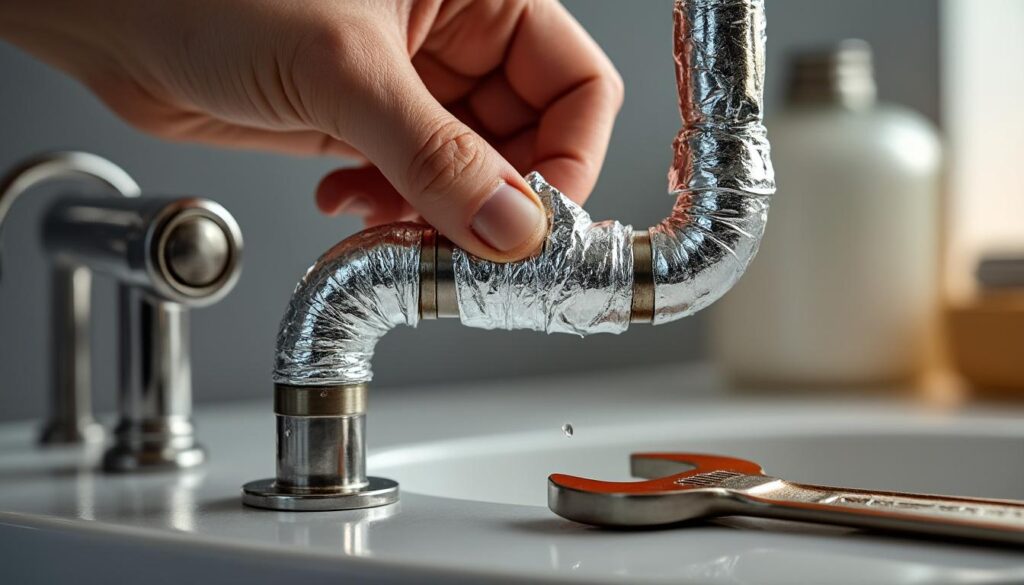
Hi DIYers, I’m Patrick! No, kitchen aluminum foil is not a reliable way to repair a leaking pipe. Turn off the water supply, limit the damage, and identify the pipe before choosing a repair product intended for that purpose. Self-amalgamating tape, repair bandages, or repair clamps should only be used within their material, temperature, and pressure limits. For more tips, also see plumbing repairs you can do yourself and when to call a professional.
Aluminum foil and leaks: why this trick isn’t reliable
A sheet of aluminum foil tears easily and cannot, on its own, form a watertight seal that withstands pressure. Adding household tape or some random glue does not make it a certified repair. Don’t confuse kitchen foil with technical tape whose instructions specify exactly what it can be used for.
Useful equipment for a suitable repair
- A container, cloths, and gloves to limit the damage.
- Access to the shutoff valve and a way to release the pressure, if the installation allows it.
- A repair product whose instructions specify the relevant material, diameter, temperature, and pressure.
- Check that it is suitable for use with drinking water, where applicable.
Steps to take before sealing an accessible water leak
- Turn off the water: shut off the relevant supply. Don’t touch wet electrical equipment; have the area made safe if necessary.
- Identify the problem: distinguish between a leaking joint, a crack, and pipe corrosion. A fitting may need a new seal rather than a repair bandage.
- Prepare: follow the product instructions, particularly for cleaning and drying. Don’t apply greasy lubricant before gluing.
- Apply the appropriate system: follow the specified overlap, number of layers, or tightening instructions; don’t apply one product’s specifications to another.
- Restore service: wait for the specified time, then gradually check for leaks. Don’t leave a persistent leak under pressure.
- Make a lasting repair: arrange to replace the defective section or have the necessary work carried out, especially in cases of corrosion.
This advice applies to an accessible water pipe. It does not apply to gas, hazardous fluids, or an unidentified pipe. A concealed or major leak, or one that cannot be isolated, requires professional attention.
Comparing emergency pipe repair solutions
| Solution | Advantages | Disadvantages | How long it lasts |
|---|---|---|---|
| Household aluminum foil | Readily available | Not a certified repair system | No reliable duration |
| Dedicated repair tape or bandage | Temporary repair when used as directed | Limitations on compatible surfaces, pressure, and temperature | Depends on the product; monitor it and plan the next steps |
| Suitable repair clamp | Mechanical repair with a seal | Pipe diameter and condition must be checked | Depends on the design and condition of the pipe |
Common mistakes to avoid
- Never attempt a repair without turning off the water: it’s the absolute basics.
- Don’t use aluminum foil or household tape as a pipe seal.
- Don’t mistake this trick for a permanent repair.
- Don’t confuse water resistance with approval for use on a pressurized pipe.
Extend the life of your repair with proper maintenance
After carrying out a repair with a suitable product, monitor the area and address the cause. Don’t let a repair bandage conceal corrosion that is getting worse.
- Inspect the patch regularly to detect any weakness.
- Avoid corrosive substances in the pipe.
- Arrange a suitable repair for the problem promptly; an emergency repair product is not automatically a permanent solution.
As the famous handyman Thomas Edison said: “Genius is one percent inspiration and ninety-nine percent perspiration.” Here, the perspiration is staying vigilant after the repair!
To learn more about how a tree’s shadow revealed a hidden leak or simply find out more about the basics of leak detection, this article is a must-read.
FAQ about repairing a pipe with aluminum foil
- Can aluminum foil be used on all types of pipes? No. There is no general compatibility that would make it advisable to use household foil to repair a pipe.
- How long does an aluminum foil repair last? There is no reliable lifespan that can be given for this trick.
- Is it necessary to use a product such as Loctite or Pattex with aluminum foil? No: don’t randomly combine glue and aluminum foil. Use a complete system designed for the specific leak.
- Can you leave the aluminum foil in place until the permanent repair is done? Don’t rely on this setup to keep a pressurized pipe sealed. Isolate the leak and arrange a suitable repair.
- When should you call a professional? As soon as the leak is major, the temporary repair fails, or you’re not comfortable handling it.
See you soon for more topics; Patrick