
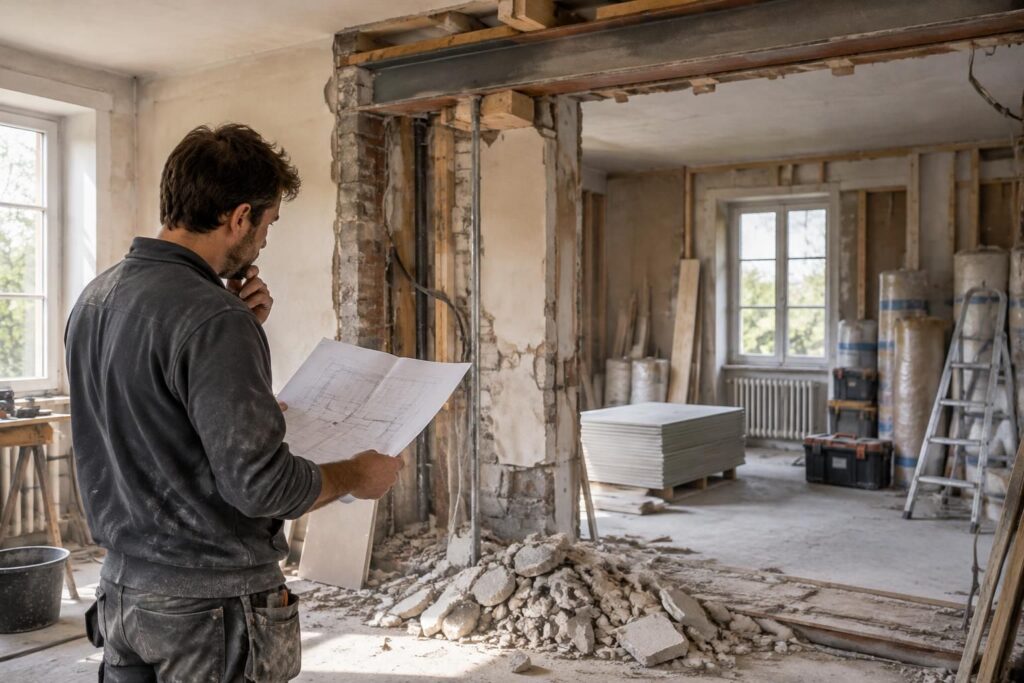
Hi DIYers, Patrick here. Yes, demolishing first can delay everything: have the property assessed and plan the order of the work before you pick up the sledgehammer. A well-planned site setup limits damage, surprises, and unnecessary expenses. Keep what is in good condition, then remove only what is really in the way of the renovation.
What to do right away
- Identify the load-bearing walls and the features you want to keep.
- Have the electrical system, plumbing, and hazardous materials checked before any demolition.
- List the items to remove, in order, from the simplest to the most delicate.
- Protect the rooms and plan how to remove or sort the rubble.
- Ask for professional advice if the structure or utility systems are difficult to identify.
Before you get started, clarify the assessment and the next steps for the project: these two reference points will help you avoid demolishing the wrong thing. To get off to a good start, read this guide to assessing before demolishing and these tips on the order of work you shouldn’t overlook.
Why demolishing too early can delay a renovation
Demolition sometimes reveals cables, pipes, or hidden damage. Without a plan, you could damage them or have to stop work to bring in a tradesperson. This discovery of unexpected issues can delay the work and drive up the budget.
A wall that looks like a simple partition may also help stabilize the building. If you knock it down without checking, you may need to have the area made safe before continuing. “Better safe than sorry”: on a job site, an assessment is often less expensive than a repair.
A DIYer had started removing a partition before noticing the electrical conduits running through it. He had to stop, have the installation checked, and redo part of the work: a few hours saved turned into extra delay.
Signs you should slow down before demolishing
Major cracks, sagging floors, persistent damp, or damaged structural elements call for a qualified opinion. In these situations, preventive demolition may be considered, but only after assessing the risks and possible solutions.
If you’re considering demolishing an entire house, compare the total cost of demolition and rebuilding with that of a complete renovation. Also check the planning rules with your local council: the required permit depends on the project and its location.
Planning the work: the order that prevents having to redo things
Planning the work helps coordinate trades and preserve what can be kept. In general, you need to locate utility systems, protect the areas being kept, remove non-load-bearing elements, and then schedule the trades in a logical order.
| Phase | Action | Delay avoided |
|---|---|---|
| Assessment | Check the structure, utility systems, and materials | Unexpected stoppage or urgent repair |
| Targeted removal | Remove items identified as unnecessary | Damage to a section that needs to be kept |
| Utility systems and structural work | Schedule the work according to the project | Having to redo work after another trade’s visit |
| Finishing | Install flooring and fixtures after messy work is complete | Damage to new surfaces |
Coordinating tradespeople matters just as much as the duration of each task. Confirm work dates and access before starting demolition: a tradesperson who arrives before the area is ready can hold up everything that follows.
Three steps to demolish without holding up the project
- Step 1 — Assess the structure, electrical system, plumbing, and condition of the materials. If you’re unsure about an item, have it checked before touching it.
- Step 2 — Plan the order of work, protection, trades’ visits, and waste removal. Allow extra time for surprises: renovation timelines vary depending on the property and the work involved.
- Step 3 — Remove the planned items gradually, starting with those that are not structural. Check the utility systems as you go and stop if you discover an unexpected problem.
If it’s a partition clearly identified as non-load-bearing, targeted removal can be scheduled after checking the utility systems. If it’s a load-bearing wall, a severely damaged house, or an element whose function is unknown, don’t start without professional advice.
This video can help you visualize the precautions to take before demolition work.
Renovating without tearing everything down: when to keep what’s there
Removing everything is not always necessary to improve comfort. A surface may sometimes be refurbished or covered, and some materials can be kept or reused. This approach reduces rubble and avoids extending the project with work that offers no tangible benefit.
On the other hand, if the structure is compromised or repairs become too extensive, more substantial demolition may make sense. Compare quotes, site constraints, permits, and expected performance before deciding: a successful project starts with an informed decision.
Practical questions to ask before demolishing
Should you always assess a property before demolition?
Yes, an assessment helps identify structural elements, utility systems, and materials that require precautions. If you are unsure about a wall or installation, ask a professional for advice.
How can you tell if a wall is load-bearing?
Plans can provide an initial indication, but they are not always enough. Have a professional check the wall before opening it up or demolishing it.
Can demolition shorten renovation timelines?
Sometimes, if it is justified and well organized. Without an assessment, permits, and coordination between trades, it can instead cause delays and rework.
What should you do with removed materials?
Sort the rubble and keep materials in good condition that can be reused. For special waste, check your local collection and disposal guidelines.
Thanks for reading this far; Patrick