
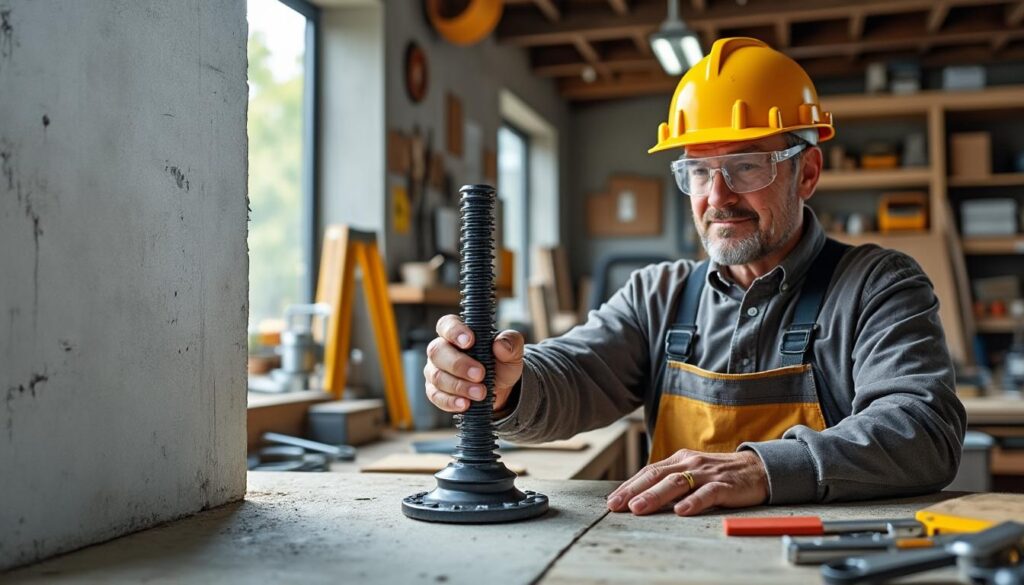
Hi, DIYers, I’m Patrick. You don’t drive a regular concrete screw directly into hard concrete without first drilling a pilot hole: “without a wall plug” does not mean “without drilling.” To avoid making any holes, you can glue certain decorative items that are compatible with the surface and adhesive. For a heavy load, a guardrail, or a safety-critical fixture, you need a properly rated system installed according to its instructions.
Fixing things to concrete without drilling: the essential solutions
Screwing into concrete without using a drill often means relying on workarounds or specialist equipment. Several techniques are worth considering:
- Self-tapping concrete screws: screws installed without wall plugs, but after drilling a pilot hole as specified in their instructions.
- Chemical anchors: resin injected into a drilled and prepared hole; this method does not meet a no-drilling requirement.
- Self-gripping or adhesive fixings for light loads, using adhesive to make up for the lack of drilling.
As Leonardo da Vinci said, “Simplicity is the ultimate sophistication.” Using the right fixing makes life easier and helps avoid many mishaps.
A railing should never be used as a test bed for an improvised fixing. Its stability affects people’s safety and requires an appropriate design. To choose installation equipment, you can refer to some simple guidelines on tools and DIY equipment.
Self-tapping concrete screws: how do they work?
Self-tapping concrete screws cut their thread into a predrilled hole of the specified diameter and depth. The term “turbo” does not eliminate this step. Check the product specifications: the material, edge distances, concrete thickness, and installation torque all affect how well the screw holds.
- Locate any utilities, then mark the positions and predrill according to the instructions.
- Use an impact driver to benefit from its high torque.
- Follow the manufacturer’s installation method and torque specifications; do not simply tighten it as far as it will go.
Note: to ensure success, it is essential to use a screw suited to the material. Don’t be surprised if you come across brands such as Pattex, Bostik, or Loctite, known for quality in adhesives and fixings.
Effective alternatives when you don’t want to drill into concrete
For light to moderate loads, and if using a drill is prohibited, several solutions may help:
- Heavy-duty adhesive strips: brands such as Scotch, tesa, and Fixatex offer a range for clever DIY projects. These strips require a clean, smooth surface to hold properly.
- Polymer or epoxy adhesives: choose a product explicitly compatible with the concrete and the item; follow the requirements for contact area, support, and curing time.
- Resin anchors: require a suitable pre-existing hole or drilling; neither the depth nor the curing time should be improvised.
If you’re looking for solutions for other materials, such as a cob wall, I recommend this article on how to attach a shelf to a cob wall.
Chemical anchoring kits for durable fastening
Chemical anchors are increasingly popular for their effectiveness and ease of use, particularly in concrete. This system consists of two components that mix in a cartridge and harden inside the hole, providing remarkable adhesion. A gun alone is not enough: drilling, cleaning, a compatible threaded rod, and curing time must all comply with the instructions.
- Clean the hole thoroughly.
- Inject the resin evenly.
- Insert the threaded rod or screw immediately.
The load capacity depends on the complete system and the substrate. Chemical anchoring is not a no-drill method.
Recommended equipment for fastening without drilling
You can’t just wing it as a DIYer without the right tools, especially when working with concrete! Here’s what you’ll absolutely need:
- Impact driver for high torque.
- Suitable self-tapping screws for concrete.
- Strong adhesive strips from brands such as Scotch or Fixatex.
- Quality epoxy or polymer adhesives (e.g., UHU, Loctite).
- Chemical anchoring kit only if drilling and the anchor design are possible.
A practical tip and something to know
When fixing something without drilling, take care to prepare the surface, for example by using a degreaser. The final strength of your installation will depend on this step. In DIY, a poorly secured item always ends up falling down. Experience shows that nothing replaces care and attention to detail.
Summary table of methods for fastening to concrete without drilling
| Technique | Type of item | Load capacity | Required equipment | Advantages |
|---|---|---|---|---|
| Self-tapping concrete screw | Medium to heavy | As specified by the design and instructions | Impact driver, turbo screws | No wall plug, but requires a pilot hole |
| Heavy-duty adhesive strips | Light | Depends on the product and surface condition | Scotch, tesa, or Fixatex strips | No tools, easy to install |
| Polymer / epoxy adhesive | Medium | Depends on the adhesive, geometry, and substrate | Loctite, UHU, or Sader adhesive | No drilling; removal may cause damage |
| Chemical anchor | Heavy | As specified by the calculation and approval | Resin + hardener kit | Durable and very strong fixing |
Frequently asked questions about fixing to concrete without drilling
Can you securely attach a heavy item to concrete without drilling?
Don’t rely on a generic adhesive solution for a heavy load or a safety-critical item. A properly rated mechanical or chemical anchor normally requires drilling; if drilling is prohibited, look for a validated freestanding design.
Are adhesive strips reliable on concrete?
On a clean, smooth surface, the best adhesive strips hold fairly well, but they are still intended only for lightweight items. They’re great for a quick fix, but not for a heavy, permanent installation.
What tools are essential for fastening without drilling?
For bonding, the main things are to prepare the surface and follow the adhesive instructions. For a concrete screw, you need a suitable drilling tool and a compliant screw-driving system.
Are concrete screws suitable for concrete blocks or brick?
Concrete screws are designed for solid concrete. For concrete blocks or brick, especially hollow varieties, use suitable wall plugs or chemical anchors.
Can you reuse a hole made for a concrete screw?
It depends on the system and the condition of the hole. Follow the manufacturer’s reuse instructions; a damaged hole should not be reused arbitrarily. Also observe the required spacing if you create another fixing point.
See you soon for more topics; Patrick